
Business
Cooking Gas Prices Fall

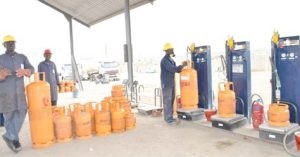
Cooking gas prices have dropped in the FCT.
NewsRain Nigeria reports that the price of cooking gas has declined across parts of the Federal Capital Territory (FCT), after months of price increases.
Meanwhile, a Nairametrics market survey showed that LPG now sells for between N1,498 and N1,650 per kilogram across Abuja, depending on the retail outlet and location, compared with recent highs of about N2,000 per kilogram recorded in several parts of the country.
At the prevailing prices, refilling a 5kg cylinder now costs between N7,490 and N8,250, while a 12.5kg cylinder costs between N18,725 and N20,625, down from approximately N10,000 and N25,000, respectively, at the peak of the price surge. However, some roadside vendors continue to sell cooking gas for as much as N1,850 per kilogram.
Energy experts attributed the recent decline to improved supply conditions but cautioned that Nigeria’s continued reliance on imported LPG leaves the market vulnerable to global disruptions.
Energy economist Dr. Dayo Abegunde said the easing in prices was a positive development for consumers but stressed that lasting stability would depend on strengthening domestic production and distribution.
READ ALSO: Price Of Cooking Gas Increases, As Marketers Fear Scarcity
“The recent decline is encouraging for consumers, but Nigeria must deepen domestic production and strengthen its supply chain to avoid recurring price spikes whenever there are disruptions in the global market,” he said.
Abegunde added that sustained price stability would require increased domestic processing capacity, improved storage infrastructure and more efficient distribution networks capable of moving LPG across the country at lower costs.
Oil and gas analyst Edward Bulus also argued that expanding domestic refining capacity and ensuring that more LPG produced within Nigeria is retained for local consumption would provide greater price stability over the long term.
He noted that while enforcement against product hoarding remained important, expanding infrastructure and improving market efficiency would have a more lasting impact on affordability.
LPG marketers attributed the recent price reduction to improved product availability at coastal depots and a gradual decline in wholesale prices.
Retail operators in Abuja also said increased competition among filling plants had contributed to the moderation in prices.
“We are seeing more product availability compared to what happened a few weeks ago. Once supply improves, retailers naturally compete for customers, and prices begin to fall,” an LPG dealer in the Kubwa area said.
Despite the improvement, operators warned that transportation costs remain high, particularly for marketers supplying inland states, adding that further investment in storage facilities and transportation infrastructure would be necessary to sustain lower prices.
Although consumers have welcomed the reduction, many households said cooking gas remains expensive compared to levels before the latest price surge.
The latest moderation in LPG prices comes after the Federal Government announced a series of measures aimed at addressing supply constraints and curbing market manipulation.
Minister of State for Petroleum Resources (Gas), Ekperikpe Ekpo, directed the Nigerian Midstream and Downstream Petroleum Regulatory Authority (NMDPRA), other regulators and security agencies to intensify surveillance of the LPG market, investigate cases of product hoarding and diversion, and sanction operators found manipulating prices.
Ekpo said the Federal Government remained committed to increasing domestic LPG supply, reducing dependence on imports and ensuring that locally produced LPG is prioritised for domestic consumption.
He also disclosed that the government is pursuing a local LPG blending initiative involving Nigeria LNG Limited (NLNG), indigenous producers and the Port Harcourt LPG plant operator to reduce logistics costs, improve supply reliability and support more stable prices.
The directives followed an emergency stakeholders’ meeting convened on June 22 to address the persistent rise in cooking gas prices.
The NMDPRA attributed the earlier surge in LPG prices to a combination of global and domestic supply challenges.
According to the regulator, global supply disruptions and price volatility arising from the Israel-Iran conflict were among the major drivers of higher LPG prices.
It also cited inadequate domestication of locally produced LPG, low import volumes, non-cost-reflective pricing by some wholesalers and retailers, poor distribution infrastructure, logistics bottlenecks and broader supply chain constraints as factors that pushed retail cooking gas prices to record highs before the recent moderation observed in parts of the FCT.
Industry stakeholders, however, maintain that while the recent decline is encouraging, sustained affordability will ultimately depend on improving Nigeria’s domestic LPG production, storage and distribution network.
The development comes as energy costs continue to exert significant inflation pressure, particularly in transportation, food distribution and small-scale businesses. Earlier this month, Nairametrics reported that Nigeria’s headline inflation rate rose to 15.93% in May 2026 from 15.69% in April.








Veekee James Clears The Air On Viral Pregnancy Reports

Cooking Gas Price Increase to N1,800/kg

Black Market Dollar To Naira Exchange Rate Today 14th November 2026

Nigerian Newspaper Headlines, Naija News for Saturday, 14th November 2026

Open Heavens Daily Devotional For Today 14th November 2026

ICYMI: See Viral Video Of Ooni Of Ife At Ex-wife Naomi Silekunola’s University Convocation

Fidelity Bank Promotes Africa’s Creative Economy At CANEX WKND 2026

Luminance Media & PR: How The Firm Is Turning Brands, People And Ideas Into Powerful Stories

Beyond Visibility: Why Cybersecurity Must Become A Priority In The Media And Public Relations Industry-By Odunlade Ifeoluwa
