News
Alleged N8.7b Fraud: Court Grants Malami, Wife, Son N200m Bail

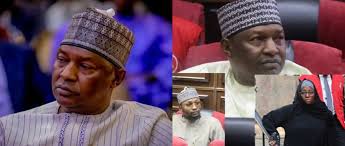
The court has granted Malami, his wife, and son N200m bail after an alleged N8.7b fraud.
NewsRain Nigeria reports that A Federal High Court in Abuja has granted bail to former Attorney-General of the Federation, Abubakar Malami; his wife, Asabe Bashir; and their son, Abdulaziz Malami.
The presiding judge, Joyce Abdulmalik, on Friday granted each of the defendants bail in the sum of N200 million, with two sureties in like sum.
READ ALSO: New IGP, Tunji Disu Removes Benjamin Hundeyin As Police PRO
As part of the bail conditions, the court ordered that one of the sureties must deposit title documents of a property located in either Maitama or Asokoro in Abuja.
The court also directed the defendants to deposit their international passports with the court.
Pending the fulfilment of the bail conditions, the defendants are to remain in the custody of the Nigerian Correctional Service (NCoS).
Recall that Malami, his wife, and son were re-arraigned on Friday before Justice Abdulmalik following the reassignment of the case.
In a 16-count charge, the Economic and Financial Crimes Commission (EFCC) alleged that the defendants conspired to launder proceeds of unlawful activities between 2015 and 2025, using bank accounts and corporate entities to conceal the source and ownership of funds totalling over N8.1 billion.
The commission alleged that the defendants routed large sums through companies linked to the Malami family, including Metropolitan Auto Tech Limited and Meethaq Hotels Limited, through transactions carried out across several commercial banks.
According to the EFCC, the funds were structured in a manner designed to disguise their illicit origin and evade regulatory scrutiny.
The charge sheet further alleged that part of the funds — including about N600 million — was retained as cash collateral for bank facilities, despite the defendants allegedly knowing or reasonably expected to know that the money was derived from unlawful activities.
The anti-graft agency also accused the defendants of using the funds to acquire high-value residential and commercial properties in Abuja, Kano, and Kebbi states, either directly or through proxies, to conceal their beneficial ownership.
According to the EFCC, the defendants conspired to indirectly acquire assets, retain control of illicit funds, and disguise the true source of the money through a network of financial transactions and corporate vehicles.



Primate Ayodele Warns Jonathan Against Presidential Ambition

Fidelity Bank Provides Critical Funding Support To Abuja Special Needs Orphanage

Unity Bank Disburses Over N500 Million Through SHOCOF To Support Traders

Power Sector Has No Quick Fix, Reforms Will Be Transparent Under My Watch – New Minister of Power, Joseph Tegbe

Popular Singer In Coma After Emergency Intestinal Surgery

Popular Reality Star Dies At 35
Black Market Dollar To Naira Exchange Rate Today 8th May 2026

Nigerian Newspaper Headlines, Naija News for Friday 8th May 2026

Open Heavens Daily Devotional For Today 8th May 2026
